
Create the shared submission record
Capture relevant information and store supporting documents with the deal. Keep the incoming submission connected to the case.
Underwriting Workflows
Bring submission emails, documents, ownership and review into one deal record. Track completeness, follow-up and controlled underwriting decisions.
THE CHALLENGE
An underwriting submission can involve emails, spreadsheets, attachments and several reviewers. Missing information, related records and follow-up tasks can become disconnected from the case. Teams need a shared record, a named owner and a visible path from intake to a reviewed decision.
FROM DATA TO DECISION
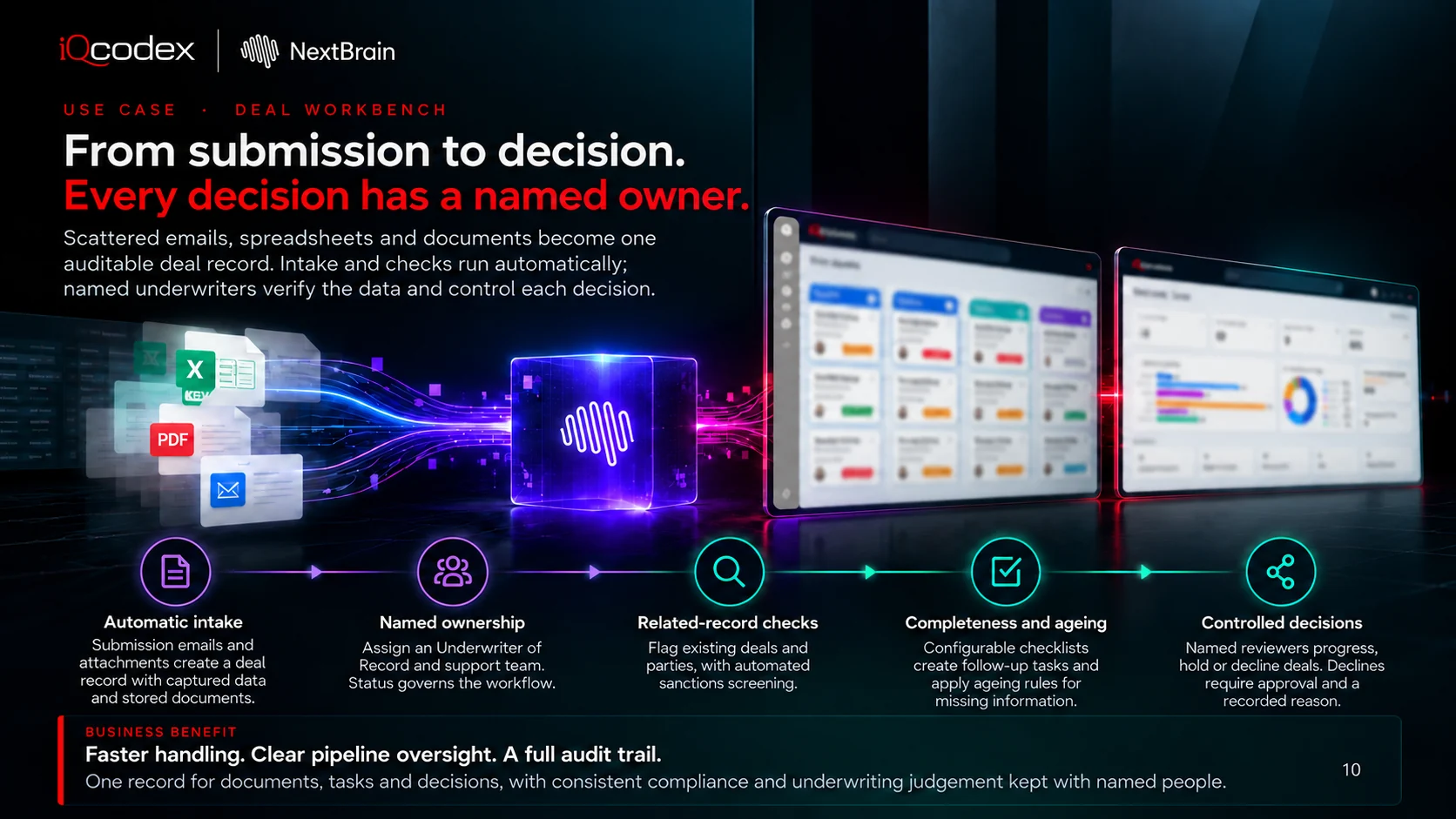
Capture relevant information and store supporting documents with the deal. Keep the incoming submission connected to the case.
Identify the underwriter and support team. Use configured checks and follow-up tasks to review related records, completeness and missing information.
Named reviewers decide whether to progress, hold or decline. Record approvals and reasons according to the agreed authority and workflow rules.
NextBrain supports the interpretation of incoming documents and data. iQsuite organizes the case, ownership, status and configured review tasks. This keeps the information-handling step connected to the people responsible for the underwriting decision.
iQ WORKFLOW + NEXTBRAIN AI
WORKFLOW USE CASE
Submission emails, spreadsheets and supporting documents can leave an underwriting case split across inboxes and teams. Missing information, related records and unclear ownership make the next action harder to identify.
The deal workbench creates one case record with captured information and stored documents. A named underwriter and support team review checks, completeness and follow-up tasks. Reviewers control progression, holds and declines, with a recorded reason where required.
What to evaluate. Evaluate completeness, routing accuracy, case ageing and the traceability of decisions. Screening and approval requirements must be scoped with the responsible team.
A shared case should show the responsible underwriter, the information still needed and the review status. Configured checklists and follow-up tasks help the team work from the same record while named reviewers retain control over progression and decisions.
Source: iQ + NextBrain FS&I Solution Overview · September 2026 · v1.0
Evaluate intake completeness, ownership accuracy, case ageing and the traceability of reviewed decisions. Compare the full workflow, including the effort needed to check captured information.
It is a shared working record for submission information, documents, tasks and reviewed decisions. Named ownership and status-driven progression keep the next action connected to the case.
Configured checklists identify missing information and create follow-up tasks. Teams can review case age and outstanding items in the workflow.
Named underwriters and reviewers retain control of material decisions. The proposed workflow records progression, holds, declines and approval requirements.
The overview describes these checks in its proposed deal workflow. Data sources, screening scope, matching behaviour and review responsibilities must be agreed and validated for a real implementation.
Workflow Automation
Tell us which decision is difficult, what data you have and which constraints matter. We will review how the approach fits your problem.