
Reconstruct remaining work
Connect orders, completed operations, compatible routes, material availability and calendars. Keep forecasts separate from confirmed physical events.
Production Scheduling
Finite-capacity scheduling for flexible job shops. Compare machine assignments, setup times and delivery impact when disruptions change the production plan.
THE CHALLENGE
Industrial scheduling connects decisions competing for the same capacity. Advancing one order may delay others; grouping work saves setup time but occupies machines another job needs. When orders, progress, routes and materials live in separate systems, the planner spends too much time rebuilding the situation before making a decision.
FROM DATA TO DECISION
Connect orders, completed operations, compatible routes, material availability and calendars. Keep forecasts separate from confirmed physical events.
Evaluate priorities, sequences and alternative machines. Show delivery delays, setup effort and commitments against keeping the current schedule sequence.
Review which orders gain or lose, record the decision and track maintenance or material actions. A proposal does not replace the approved schedule without human intervention.
SEE IT IN ACTION
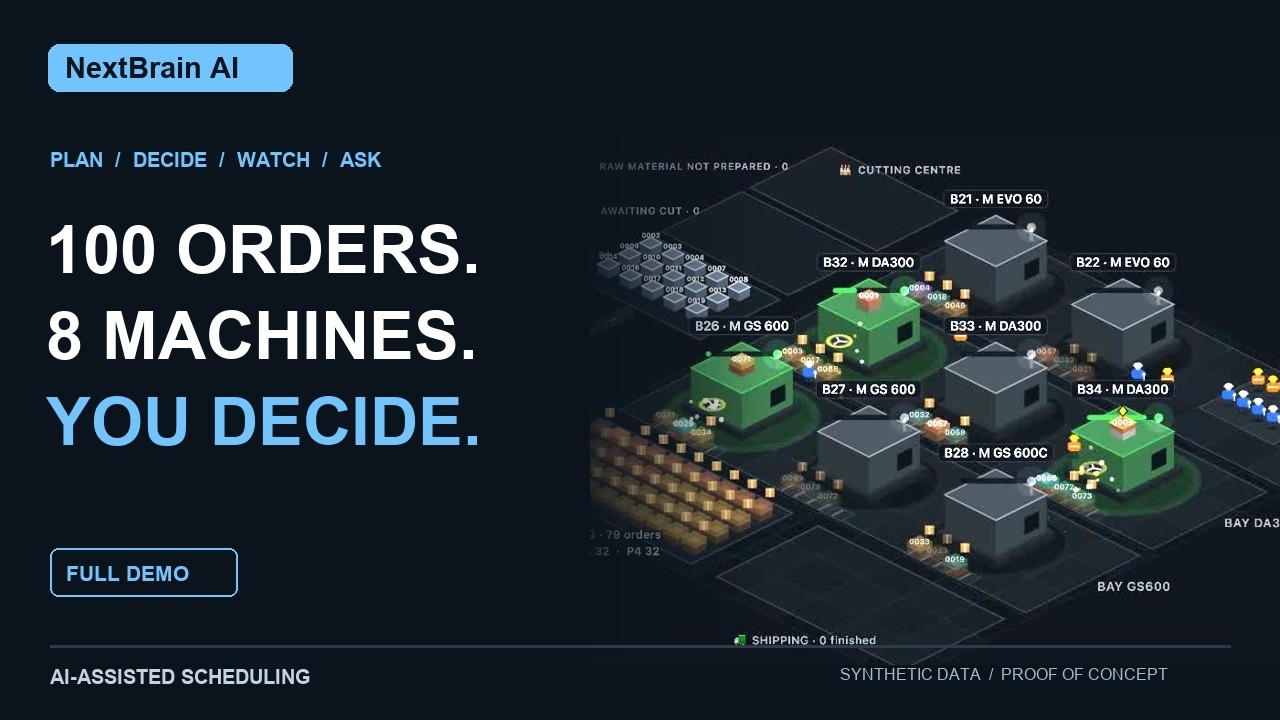
Watch practical NextBrain demonstrations of production scheduling, restaurant planning and insurance premium prediction. Explore the workflow, model outputs and decisions each example supports.
 2:28
 8:45
Videos in English · NextBrain AI channel
We use machine learning and neural networks to support production planning and the evaluation of complex scheduling decisions. The approach considers machine capacity, routing, materials and delivery priorities, helping the planner compare alternatives and assess their operational impact before approval.
PRODUCTION SCHEDULING / TECHNICAL GUIDE
The demonstrated manufacturing problem belongs to the flexible job shop scheduling family: each order follows a sequence of operations, with a restricted set of eligible machines or approved route alternatives. Machine assignment and operation sequencing must be considered together. Breakdowns, material updates and priority changes make the problem dynamic. This is a classification of the demonstrated case, rather than a claim to support every job-shop variant. FJSP review ↗ Dynamic scheduling review ↗
| Constraint | What the plan must respect |
|---|---|
| Routing and precedence | Complete the required phases in route order. Preserve the selected route version and the restrictions on moving work already in progress. |
| Machine eligibility | Use the machines permitted by the routing master. Keep multi-phase complete-part work on the same machine where the case requires it. |
| Finite capacity and calendars | Respect shifts, non-working windows, planned downtime and registered outages. Productive work can continue across shifts without restarting its setup. |
| Material release dates | Do not schedule work before its modeled material availability. Distinguish an expected arrival from a physically confirmed receipt. |
| Setups and grouping | Account for preparation and eligible consecutive-order grouping without splitting a manufacturing order into transfer sublots. |
| Due dates, priorities and commitments | Compare completion against the relevant need or requested date. Surface conflicts with protected commitments instead of silently accepting them. |
| Execution state and schedule stability | Preserve completed quantities, existing progress and configured frozen work. Compare revised proposals with the approved schedule. |
A useful production schedule must account for delivery dates, business priorities, setup effort and the stability of work already planned. The goal is to make the consequences of each alternative visible, so the responsible person can assess the trade-offs before approving a change.
We use machine learning to support the analysis of production-planning problems and help teams assess alternatives in the context of their data and operating constraints.
Neural networks support the planning approach where appropriate to the project. Their role is to help address complex relationships between operations, capacity and delivery priorities.
Proposed plans must respect the modeled manufacturing constraints. The planner can review delivery impact, compare alternatives and approve the next step.
ILLUSTRATIVE MANUFACTURING CASE
Use the synthetic portfolio shown in the video: 100 orders across eight machines. Read the existing sequence, work in progress and delivery commitments.
Register a machine breakdown and its expected repair time. Add an urgent request as a separate planning event. An expected repair does not confirm physical availability.
Inspect what happens without intervention, whether compatible work can move and how a revised sequence affects other orders, setup effort and delivery dates.
Review the trade-offs, resolve commitment conflicts and record the reason for approving or rejecting a proposal. Continue tracking repair or material actions separately.
This combined walkthrough explains a scenario supported by the project. The linked short and full videos show selected demo flows; they should not be interpreted as evidence that every event above occurs in a single recording.
Watch the production scheduling demonstrations ↑Compare alternatives under the same operating conditions. Review delivery delays, commitment conflicts, preparation time, changes to the existing plan and the effort needed to reach a decision. The demonstration uses synthetic data; project-specific results must be evaluated against an agreed operational baseline.
These references establish the academic and industrial vocabulary. The mapping to NextBrain’s demonstration follows the project’s own manufacturing scope and operational requirements.
Academic terminology, machine flexibility and problem extensions.
Dynamic scheduling, disruptions and rescheduling research.
Compare priority-specific lateness, affected commitments, setup hours and planner effort on the same scenario. A useful result must preserve completed work and agreed constraints as well as improve the selected measures.
Scenarios support incidents and requests, impact comparisons and replanning proposals. Repairs and receipts require their own confirmation; a forecast does not make them completed events.
The responsible person decides. Alternatives show consequences before approval, and conflicts with commitments require the appropriate authority.
It combines the choice of eligible machines with the sequencing of operations, subject to routing and capacity constraints. The demonstrated case is a constrained variant with route versions, same-machine rules, calendars, material availability and protected commitments.
Finite-capacity scheduling creates detailed plans within available resource capacity. Advanced Planning and Scheduling (APS) is the broader industrial category. This demonstration addresses a defined scheduling and rescheduling use case, rather than every function of a complete APS suite.
They support production planning and the assessment of complex scheduling decisions. Their role depends on the project and available data. The planner reviews the proposed alternatives and their operational consequences before approval.
Optimization & Planning
Tell us which decision is difficult, what data you have and which constraints matter. We will review how the approach fits your problem.