
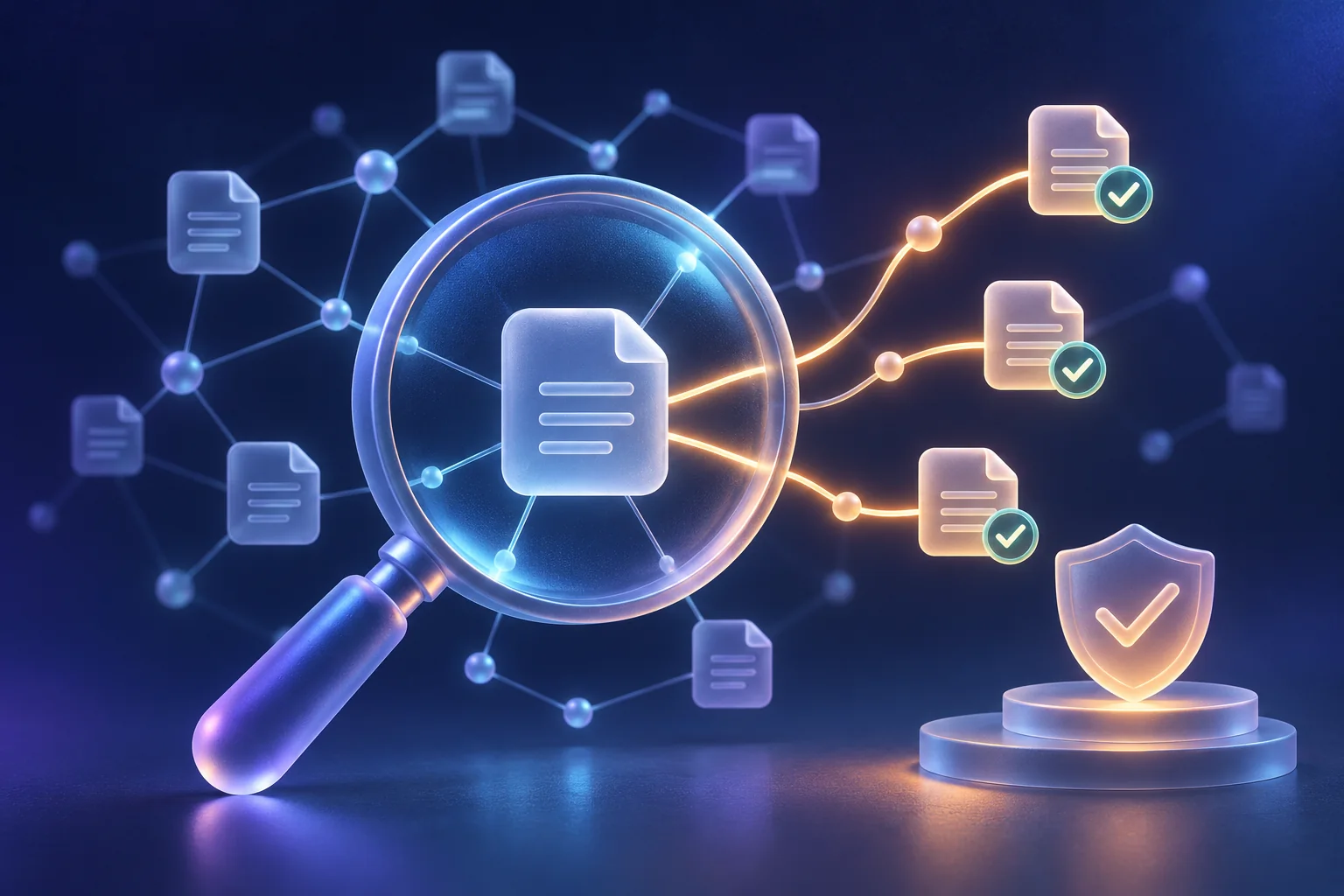
Finding a relevant paragraph does not always answer a business question. A procurement team may need to connect a supplier, its parent company and several contracts to understand a dependency. GraphRAG adds a representation of entities and relationships to retrieval, helping a system investigate questions that span multiple sources.
On September 14, 2026, AWS published a shared implementation of GraphRAG and LightRAG. The announcement provides a concrete example of testing different graph retrieval methods on a common infrastructure, rather than assuming one approach fits every query.
How does GraphRAG differ from standard RAG?
Retrieval-augmented generation typically finds passages related to a question and provides them to a language model. That works well when the needed evidence appears in a small number of identifiable sections.
A graph adds explicit connections: an organization owns a subsidiary, a contract covers a service or a document supersedes another document. Retrieval can then use those relationships to assemble evidence. Our plain-language introduction to RAG explains the underlying retrieval pattern.
Choose questions that need connected evidence
An illustrative supplier review might ask which agreements involve companies belonging to the same group. A conventional search can find individual supplier names. A relationship model can help connect those names, provided ownership information is accurate and current.
Graph retrieval is less compelling for a straightforward question such as finding a cancellation clause in one contract. A simpler search method may answer that question with less preparation and lower operational cost.
The graph needs its own quality checks
Entity extraction can confuse organizations with similar names or treat one company as several different entities. Relationships can also be outdated, incomplete or inferred incorrectly. Those errors affect the evidence the model receives.
Preserve a reference to the source behind each important relationship. Track effective dates and define how the graph changes when a document is replaced. Apply access restrictions to retrieved evidence and derived summaries, not just to the original files.
Compare value against the extra work
Create a test collection containing direct lookups and questions that require several connected facts. Compare a conventional RAG baseline with the graph approach on answer correctness, supporting evidence and response time.
Include the cost of building, refreshing and checking the graph. A better answer on a difficult question may justify that work, while a marginal improvement across simple queries may not. Keep the evaluation grounded in the questions your employees actually need answered.
A decision rule for choosing graph retrieval
Choose a graph pilot when important questions repeatedly require joining named entities, tracing dependencies or reconciling relationships across sources. Keep conventional retrieval as the baseline for questions answered by a single passage. Both approaches still need citations that actually support the answer.
During evaluation, remove one supporting relationship and check whether the system admits that the chain is incomplete. Also test conflicting dates and similarly named organizations. These cases reveal errors that a fluent summary can conceal. Establish reliable enterprise context first, and use a common evaluation process to decide whether the extra graph maintenance is justified.
Build from a reliable knowledge foundation
Before adding a graph, check document quality, version control and basic retrieval. The progression described in our RAG to RAPTOR article also starts with those foundations. Explore a knowledge repository and discuss your search questions with NextBrain AI to identify where relationships could add value.